In praise of randomness: lessons from Nassim Taleb on antifragility
I recently got hold of Nassim Nicholas Taleb's Antifragile: Things That Gain from Disorder [1], the fourth book of his Incerto series and the last one I had left to read. Since I read The Black Swan [2] a couple of years ago I have slowly worked my way through the rest of the series (all except The Bed of Procrustes), and I keep coming back to his insight on the nature of complex systems: we make strong assumptions about the future based on very poor information, and we deny the role that randomness plays in our expectations.
This has changed the way I see the world and how I act in daily life. After putting my own "skin in the game" [3], both in financial markets and in my attempts to reach my professional goals, I am definitely less scared of taking risks. Not because risk went away, but because I understand better which risks can hurt me and which ones can only teach me something. Some of the credit also goes to Annie Duke's Thinking in Bets [4], from which I learned valuable lessons, most of all to avoid "resulting": judging my decisions by their outcome. A good decision can end badly through bad luck and a bad one can end well, so the outcome alone tells me surprisingly little about whether I chose well.
In this post I give a general overview of his ideas, then look at the two places where they are easiest to see (financial markets and evolution), and finish with the place I know better: weather prediction, where randomness is not an enemy to be removed but an ingredient we add on purpose.
Fragile, robust, antifragile
Taleb's starting point is that we lack a word. We have a word for things that break under stress (fragile), and we tend to think the opposite is robust or resilient. But a robust thing just does not care about stress. The real opposite of fragile is something that gains from stress, volatility and disorder. Since no such word existed, he made one up: antifragile.
He illustrates the triad with three figures from mythology:
- Damocles (fragile): one thread breaks and the sword falls.
- The Phoenix (robust): it burns and comes back exactly as it was.
- The Hydra (antifragile): cut off one head and two grow back.
A practical way to tell them apart is to ask what happens when you add variability. A porcelain cup on a train only has a downside: shaking can break it, it can never improve it. Your muscles and bones are the opposite: stress them within limits and they come back stronger. In Taleb's language, the fragile has a concave response to shocks (more to lose than to gain) and the antifragile a convex one (more to gain than to lose). That asymmetry, not the ability to predict the shock, is what matters.
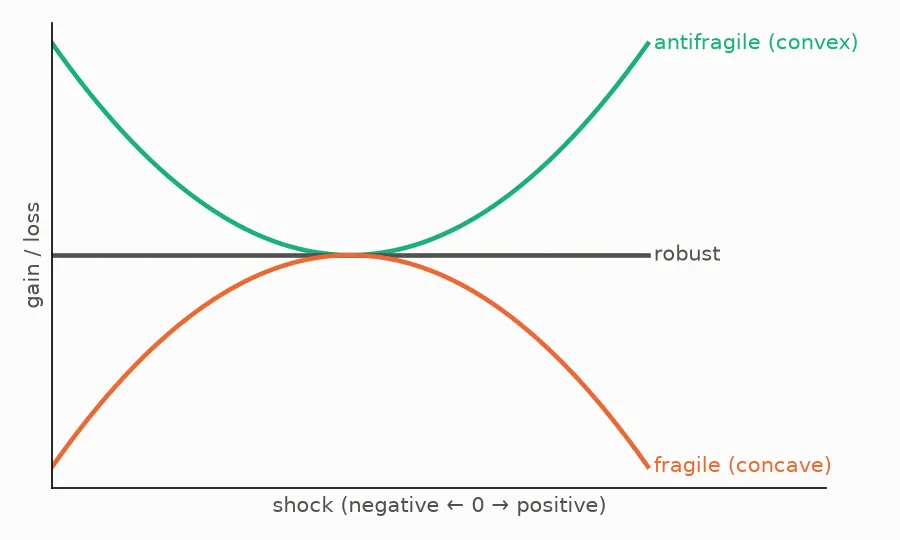 Fragile, robust and antifragile as responses to a shock. The convex curve gains from shocks in either direction, the concave one loses from both. My own sketch of the idea in [1].
A few ideas follow from that and run through the whole book:
- The turkey problem. A turkey is fed every day for a thousand days, and each day its confidence that humans are kind grows, until the day before Thanksgiving. Calm in the data is not evidence of safety. Often it is the opposite: suppressing small shocks lets hidden fragility accumulate.
- The taxi driver and the bank clerk. Taleb contrasts two brothers: one with a steady salary at a bank, one a taxi driver whose income varies every day. The taxi driver looks riskier, but his small daily variations keep him adapting. The bank clerk looks safe until one layoff takes his income to zero.
- Iatrogenics. Harm caused by the healer. Intervening in a system that would correct itself (overmedicating, micromanaging an economy, smoothing every fluctuation) often does more damage than the problem.
- Via negativa. We usually know better what is wrong than what is right, and removing things (debt, bad habits, unneeded complexity) is more robust than adding them.
- The barbell. Instead of putting everything in "medium risk", combine something extremely safe with small bets that have a large, open upside. The worst case is bounded, the best case is not.
- Optionality. If you have the right but not the obligation to do something, you do not need to predict the future. You only need to recognise a good outcome when it shows up.
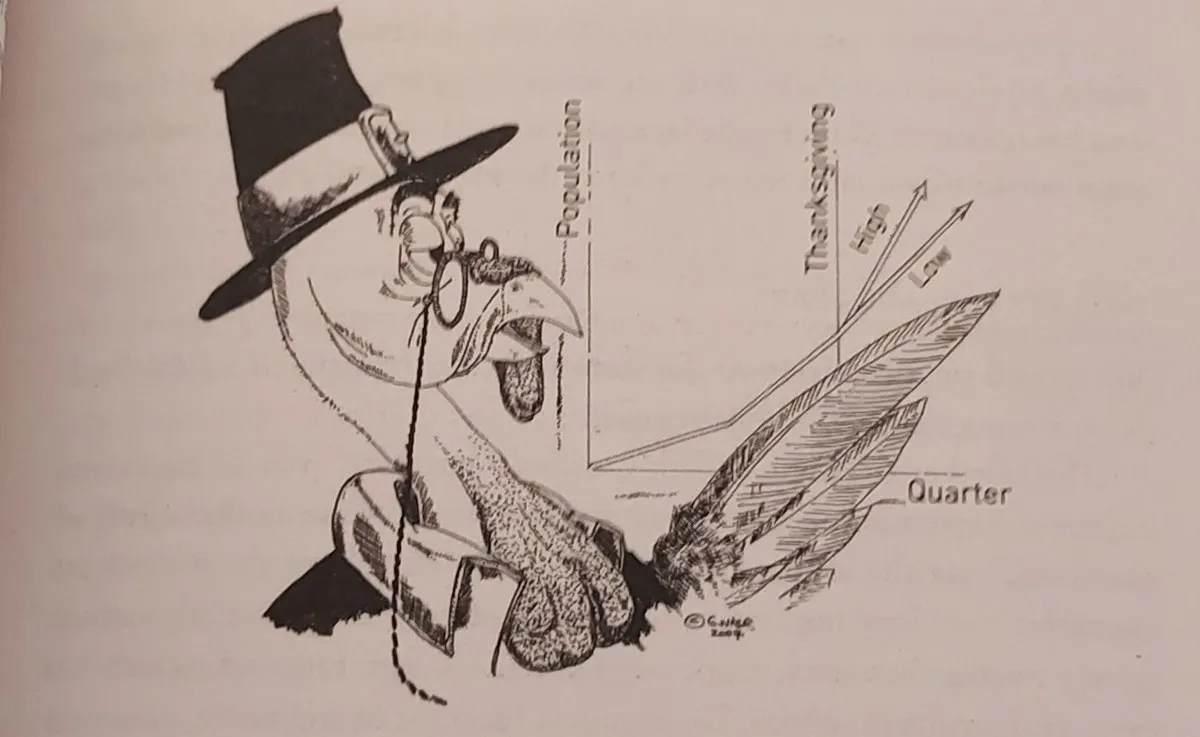 A turkey using "evidence": unaware of Thanksgiving, it is making "rigorous" future projections based on the past. Figure 4 in Antifragile [1], drawing by George Nasr.
Skin in the game: who pays for the error
Skin in the Game [3], the last book of the series, develops an idea that is already present at the end of Antifragile: a system can only gain from errors if the people who make them pay for them. When the cost of a mistake falls on someone else, the mistake carries no information back to whoever made it, and nothing is learned. Taleb likes to quote Hammurabi's code: if a builder builds a house and it collapses and kills the owner, the builder shall be put to death. Brutal, but the builder has every reason to build well, because he knows more about the hidden risks of the house than anyone else.
This is the link between the two books. Antifragility at the level of a system needs fragility, and accountability, at the level of its parts. Remove the consequences (bail out the bank, protect the bad restaurant, shield the expert whose predictions never come true) and you remove the filter that made the system improve.
The other idea that stayed with me from that book is the minority rule. Take four friends going out for dinner, one of them vegetarian. The meat eaters will happily eat vegetarian food, but the vegetarian will not eat meat, so the group ends up at a place that serves vegetarian food. A small, inflexible minority sets the rule for everyone, because the flexible majority does not mind. Taleb uses the same mechanism to explain why so many drinks are kosher, or how a determined minority can change a norm long before it becomes a majority view. It is another case where averages are misleading: the outcome is decided by the asymmetry, not by the head count.
Financial markets: where Taleb learned about fragility
Taleb spent two decades as an options trader, and that is where the ideas come from. An option is the cleanest example of convexity: you pay a small, known premium, and in exchange you get a payoff that can be very large if something unexpected happens. The seller of the option has the opposite profile: a small, steady income most of the time, and a large loss on the rare day the market moves violently. Most of the time the seller looks smarter. Then the turkey's Thanksgiving arrives.
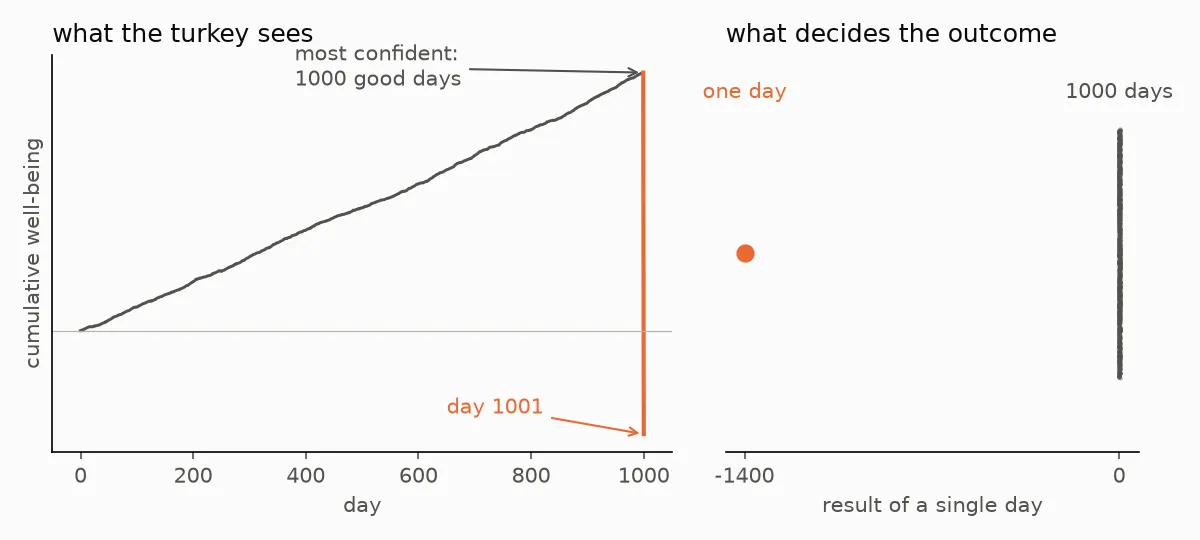 Left: a thousand small, mostly good days build confidence, and one day erases them. Right: the same days as single results; the outcome is decided by the one far to the left, not by the thousand clustered near zero. Synthetic numbers, after the turkey example in [2].
The 2008 financial crisis is his favourite example of fragility built from apparent stability. Banks reported smooth profits year after year while holding exposures that could (and did) wipe them out in weeks. Their risk models assumed that large moves were vanishingly rare, so the models said the system was safe exactly when it was most fragile. And because the largest banks were bailed out, the losses were moved to taxpayers while the bonuses stayed with the bankers: the opposite of skin in the game.
The lesson I took for my own (much smaller) investing is not "predict the crash". It is to ask, for each position, what the worst case looks like and whether I can survive it, and to keep most of my money boring so that a few small bets can afford to be bold.
I learned this the hard way on a small scale. Some time ago I started a trading experiment with short-term bets where the most I could lose was the price I paid, the same payoff you get from buying a cheap option that expires in a few days. In the beginning I only risked tiny amounts, and I still lost money, not because the bets were bad but because I was nervous. With repetition I got used to the swings and became comfortable taking larger positions, always within a loss I knew I could absorb. Looking back, the early losses were the cheapest part of the lesson: small, frequent errors that taught me something, exactly the kind Taleb says a system should welcome. And, thanks to Duke, I try not to judge each bet by how it ended, only by whether it was a good bet when I made it.
Evolution: the system gains from the fragility of its parts
Evolution is the original antifragile system, and the key point is about levels. An individual organism is fragile: it gets sick, it dies, its mutations are mostly harmful. But that fragility is exactly what makes the population and the species antifragile. Random mutations are mostly errors, and selection keeps the rare ones that work. Without variation and without death there is nothing to select from.
This is not a new idea, and Taleb is not the first to put randomness at the centre of it. In Chance and Necessity (1970) [5] the biologist Jacques Monod, who shared the 1965 Nobel Prize for work on gene regulation, argued that all novelty in living things comes from chance: random errors in the copying of DNA. Necessity is the other half: the copying machinery is extremely faithful, and selection keeps only the errors that work. This process is shaped like a barbell. Life keeps a very safe base (copy almost everything perfectly) and makes a few small, cheap bets (a handful of random mutations per generation), most of which fail at no cost to the species, and a few of which pay off enormously.
The overlap has limits. Monod writes as a molecular biologist and a philosopher: his point is that nature has no purpose, and that we have to accept being the product of chance. Taleb writes as a trader: his point is about exposure, how to arrange your life so that randomness works for you rather than against you. Monod describes how randomness creates; Taleb tells you how to stand in front of it.
Taleb applies the same logic to human systems. Restaurants fail all the time, and each failure is a tragedy for its owner, but the restaurant industry as a whole improves because of those failures. Every airplane crash is investigated and the lessons are built into the next generation of procedures and aircraft, which is why flying keeps getting safer. The system learns from the errors of its parts, as long as those errors are small, frequent and not hidden.
Our bodies work the same way on a smaller scale. Hormesis is the observation that a small dose of a stressor (fasting, cold, exercise, some toxins) triggers an overcompensating response. Remove all stressors and the body weakens.
Weather prediction: randomness as an ingredient
This is where the book connected with my own work. Weather prediction is a field that, over the last 60 years, moved from trying to remove randomness to embracing it, and I think several of its best ideas are antifragile in Taleb's sense.
Admitting we cannot predict the details. In 1963 Lorenz showed that a simple model of convection is extremely sensitive to its initial conditions [6]: two almost identical starting states end up in completely different places. The atmosphere behaves the same way, so a single deterministic forecast is, in Taleb's terms, a forecast that pretends to know more than it does. The answer was ensemble forecasting: run the model many times from slightly perturbed initial conditions and look at the spread. ECMWF has run an operational ensemble since 1992 [7]. The forecast is no longer one answer, it is a distribution, and the spread tells you how much to trust it. This is a step from fragile to robust: the forecast does not collapse when the atmosphere does something unexpected, because the unexpected was already among the members.
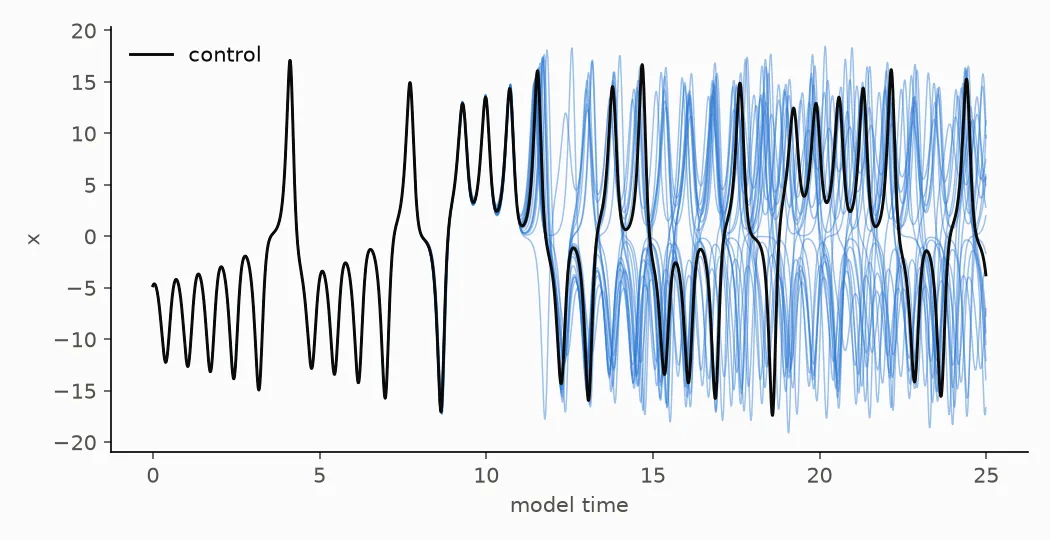 Twenty runs of the Lorenz (1963) model [6] started from almost identical states (blue) and the unperturbed run (black). They agree for a while and then spread over everything the system can do.
Adding noise on purpose makes models better. The part of numerical models that represents processes too small to resolve (clouds, convection, turbulence) is called parametrisation. Traditionally it is deterministic: the same large-scale state always gives the same small-scale effect. In reality the small scales are noisy. In the late 1990s ECMWF started perturbing the tendencies from the parametrisations with random noise (stochastic physics) [8]. The surprising result, and the one that reminded me of hormesis, is that the noise not only improves the spread of the ensemble, it can also reduce some of the systematic biases of the model itself [9]. The model gets better, not just more uncertain, by being shaken.
Every busted forecast feeds the next one. Data assimilation, the process that builds the starting point of every forecast, runs on errors. Each cycle compares the previous short forecast with new observations, and the difference (the innovation) is what corrects the model state. Without those errors there would be nothing to learn from. On longer time scales, verification works like the airline crash investigations: forecast failures are studied, written up, and the lessons go into the next model version. A forecasting system that hid its failures would stop improving. Weather forecasters also have skin in the game in a way few other predictors do: the forecast is checked against reality the next day, in public, and scores are tracked for decades. Compare that with economic forecasts that are rarely revisited when they miss.
Decisions are about asymmetry, not accuracy. The classic cost-loss model of forecast value [10] says: if protecting yourself costs C and the loss you avoid is L, you should protect whenever the probability of the event is larger than C/L. If protection is cheap and the loss is large, you should act even when the event is unlikely. This is exactly Taleb's point about convexity: you do not need to predict the event, you need to know the shape of your payoffs. It is also why a probability from an ensemble is worth more than a single "yes" or "no".
The turkey in climate statistics. When we estimate how often an extreme event happens (the "100-year flood") from a few decades of observations, we are making the turkey's inference: the past record is calm, so the future will be too. Extreme precipitation has heavy tails, the climate is changing, and the record is short. The largest event in the record is not the largest event possible.
Learning from noise, literally. In my previous post on diffusion models I described how these models learn what weather maps look like by practising one task: removing noise from them. They are trained on disorder, and they would learn nothing without it. It is hard to think of a more literal example of something that gains from randomness.
One honest caveat. Most of these examples make the forecast robust rather than antifragile: an ensemble does not get stronger when the atmosphere surprises it, it just does not break. The antifragile part is the forecasting system as a whole: the community, the verification, the model development cycle, which feeds on its own failures in the same way as Taleb's restaurants and airlines.
What I take from it
"I love randomness", Taleb writes [1]. I have come to agree with him, even at home. Against my wife's wishes (she likes an orderly living room, and an orderly everything around it, so she does not feel stressed) I like having piles of books and papers around me. To her they are a mess. To me they are where the unexpected connections come from.
Working in weather, I am very aware of how important and how unavoidable uncertainty is. That feels worth repeating at a time when the supposed magic of AI is reaching every area of human knowledge, and some people claim, with a fair amount of arrogance, that AI will solve all the problems of science. Chaos and uncertainty are permanent features of reality, and I do not expect that to change any time soon. If anything, the opposite: as AI helps us push our knowledge of maths and physics further, we will most likely also discover how much larger the unknowable part of the physical world is. A bigger island of knowledge has a longer shoreline with the unknown. Better weather models did not remove chaos; they told us more precisely where predictability ends.
So I have learned to live with uncertainty, and to accept that the best I can do is act with the best information at hand. Every decision will be surrounded by uncertainty. In practice that means a few simple rules:
- Fear small, survivable losses less, and hidden, large ones more.
- Keep a barbell in my career as in my savings: a stable base, plus small bets with an open upside (side projects, this blog).
- Judge a decision by how it was made, not by how it turned out.
- Distrust a single number, in a forecast or anywhere else, and ask instead what the spread and the payoffs look like.
References
[1] Taleb, N. N. (2012). Antifragile: Things That Gain from Disorder. Random House.
[2] Taleb, N. N. (2007). The Black Swan: The Impact of the Highly Improbable. Random House.
[3] Taleb, N. N. (2018). Skin in the Game: Hidden Asymmetries in Daily Life. Random House.
[4] Duke, A. (2018). Thinking in Bets: Making Smarter Decisions When You Don't Have All the Facts. Portfolio.
[5] Monod, J. (1970). Le Hasard et la Nécessité. Éditions du Seuil. English translation: Chance and Necessity (1971), Knopf.
[6] Lorenz, E. N. (1963). Deterministic nonperiodic flow. Journal of the Atmospheric Sciences, 20(2), 130-141.
[7] Molteni, F., Buizza, R., Palmer, T. N. and Petroliagis, T. (1996). The ECMWF Ensemble Prediction System: Methodology and validation. Quarterly Journal of the Royal Meteorological Society, 122(529), 73-119.
[8] Buizza, R., Miller, M. and Palmer, T. N. (1999). Stochastic representation of model uncertainties in the ECMWF Ensemble Prediction System. Quarterly Journal of the Royal Meteorological Society, 125(560), 2887-2908.
[9] Berner, J. et al. (2017). Stochastic parameterization: Toward a new view of weather and climate models. Bulletin of the American Meteorological Society, 98(3), 565-588.
[10] Richardson, D. S. (2000). Skill and relative economic value of the ECMWF ensemble prediction system. Quarterly Journal of the Royal Meteorological Society, 126(563), 649-667.